







After months of preparation, the day has finally arrived. Rows of students sit in silence, eyes fixed on glowing screens as they click through questions, each second marked by the steady pressure of a ticking clock.
Sitting in a room taking a test that can determine college credit, students face both pressure and excitement. For senior Sophia Hart, the nerves going in are quickly forgotten once the test begins.
“It’s really not that bad,” Hart said. “You’re kind of in the zone, so you’re not thinking about being worried or getting something wrong, just trying to get it done.”
Hart’s calmness with AP exams comes from the way she prepares.
“If it’s math or science I’ll do practice questions on AP classroom,” Hart said. “If it’s English, I’ll review my notes. I feel like it’s the same way you study for any class, just sometimes you have to get more vigorous with it.”
Hart, who will attend the University of Notre Dame in the fall, said though the University will not accept all her AP credits she believes that the rigorous courses will help her succeed.
While AP courses can provide college credit, they also provide an opportunity for students to experience the environment of a college-level course before ever stepping foot on campus.
“Studies have found that even a student who makes a 1 or a 2 on an AP exam is more likely to graduate from a four-year college on time than a student who did not take an AP class in high school.” AP Coordinator Jennifer Collins-Worthington said.
As a college preparatory school, 25 AP courses are offered, providing a variety of opportunities for students to achieve academic success. Principal Andrew Worthington encourages students to take on these academic challenges.
“Taking on that challenge and trying something new is a chance to see one’s potential and the gifts that God has given,” Worthington said. “I’ve seen many times someone take on a challenge, maybe not pass the test, but then come back with a confidence they’ve never had before and reach their academic goals and pass the test the next year.”
When taking advantage of AP exams, students can earn 50 or more college credits and potentially begin college as a second-semester sophomore. For senior Tony Huynh, that is a reality. He plans to attend the University of Oklahoma in fall entering at the level of a second-semester sophomore, nearing junior standing.
“I think [AP classes] push me to really try,” Huynh said. “Otherwise, I do my homework and go to bed, but they push me to give 110%. Not like I want to give 110%, but I think they’re more rigorous than the on-level courses that I’ve heard other people are taking, and I think it helps build good habits that will hopefully help in college.”
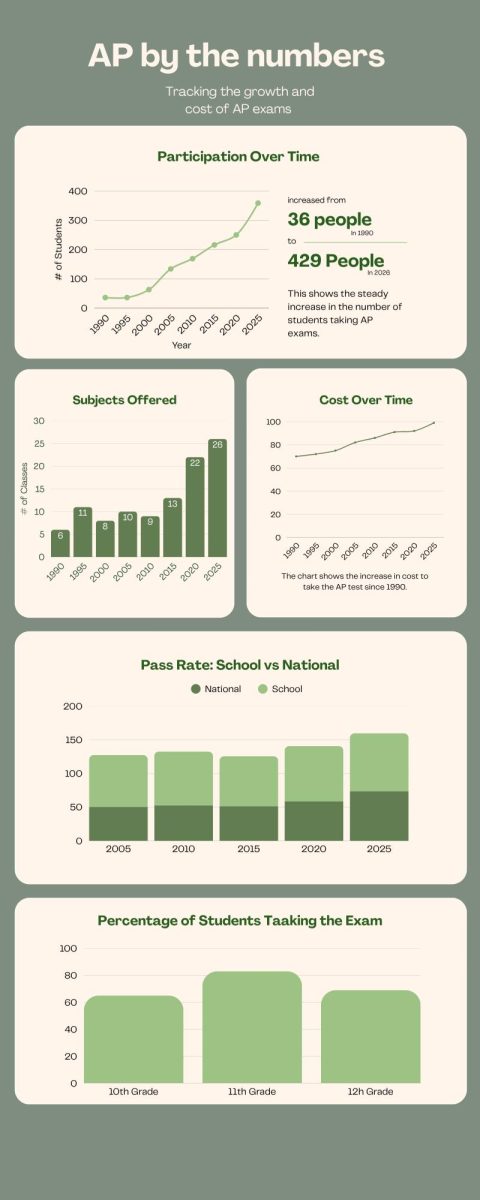
AP tests can save students thousands of dollars. While it might cost $100 to take an AP exam, it is estimated that Huynh will save approximately $20,000 when factoring in his college tuition, room and board.
At BMCHS, the AP program has grown vastly over the past 20 years, expanding from 63 to 429 students and increasing the number of subjects offered from 8 to 25.
“I think the growth is due to two factors,” Collins-Worthington said. “We have greatly expanded our course offerings, allowing students’ opportunities to find maybe a single AP course that is to their interests, and we have also built a culture that encourages students to take academic risks. We don’t gatekeep our AP program. As a Catholic school, we recognize the potential of all of our students, and we have encouraged equity and access to all of these courses to our students.”
As the program continues to grow, it allows the school to better replicate what a real college exam environment looks like.
“Depending on the course at college, exams may be taken in a classroom, lecture hall or gym with 100 plus students,” Worthington said. “The way we administer the tests replicates that experience so that when [students] take exams in college, they’ve practiced, experienced and had success taking a content heavy test in a college style environment.
From building study habits to earning college credit, AP students and teachers agree the tests are more than a credit; they are the foundation for success after high school.