





It has been around 1,300 years since Latin became a dead language after the fall of the Roman Empire. However, the language continues to live in the modern world. In fact, the word “language” stems from the latin word “lingua,” which means “tongue.”
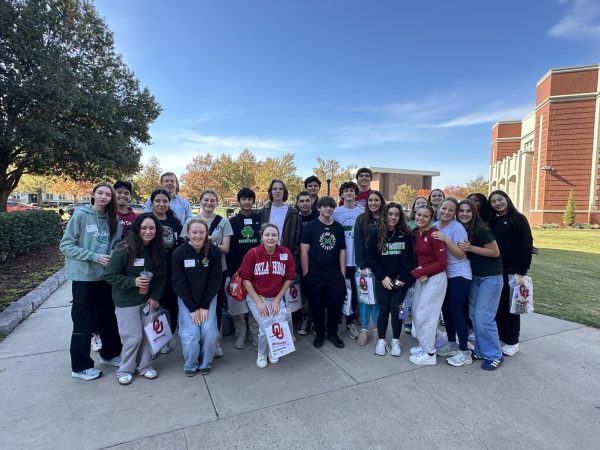
Nov. 6, the Latin Club visited the University of Oklahoma to attend their Department of Classics’ 33rd Annual OU Classics Day. At the event, students had the opportunity to roam around the university’s Student Union to choose amongst various lectures and activities pertaining to ancient languages, mythologies and cultures.
“I really liked how each event was interesting on its own,” Latin Club member Ethan Do said. “My favorite was probably the Gladiator one — we learned more about how they fought back in the day.”
Latin Club adviser Travis Kirk believes the experience helped students gain an interest in classic languages. He encourages students to participate as it can open up a whole new world of strengths.
“Latin is really inflected, so the word order is very flexible, and it’s more complicated,” Kirk said. “I think those analytical skills translate into skills that you use in many career fields where you really have to perform a deep analysis.”
Latin Club Vice President Caragan Maracci realized that learning about classical history can aid people in understanding the English language.
“In certain English classes, I understand a lot of root words,” Marcacci said. “It just gives you a base understanding.”
Kirk noticed how Latin is heavily involved in academics, particularly within advanced learning and higher education.
“It’s good for people going to professional schools or taking the ACT and SAT,” Kirk said. “Big words tend to come from Latin and Greek, so you could say it builds vocabulary.”
Another benefit Marcacci has observed from learning classical history is that the languages can help people understand the current world through comparison to the past.
“It helps me understand politics because we use a lot of the same policies and types of leadership they did,” Marcacci said.
Outside of history, students also got to learn about college life. Some of the lectures offered in-depth advice on the college application process as well as general information about attending a university.
“It was really fun and interesting to see what it would be like in the future to go to a college class,” Latin Club member Max Silvernail said. “We went to a lot of stuff that were like college lectures.”
The event also gave students the opportunity to roam around the school as if they were actual university students. They even got to eat lunch on the campus.
“You got a good feel for the campus, like it kind of felt like you were at college, so that was nice,” Latin Club member Lucy McBride said. “You weren’t really on a tour, so you got to kind of look around on your own.”
The many professors at the event motivated students to consider getting a minor or a second major in a classical language, noting their importance in everyday life.
“Learning a classical language, a really complicated language, gives you analytical skills that transfer to so many different career fields,” Kirk said. “They had professors down there in the Classics Department who were talking about the benefits of studying it in combination with any other major.”